Showing posts with label vipul ramanuj. Show all posts

Thursday, June 18, 2015

Demon on the Road

Rusty-spotted Cat (Prionailurus rubiginosus)
There’s nothing better than winding up a hectic day with a long peaceful drive, simply to enjoy a pleasant evening with a brisk of subtle cool breeze along with a company of a few friends and loved ones. The traffic is smooth, with no mad hour rush; the drive is coupled with some great conversations, laughs over silly jokes and a general ‘having a good time’ state of mind. Without any warning, the good time is interrupted by a nasty smell and a gory sight of an animal lying ragged on the road, mutilated. What follows immediately after, is a combination of quick reflexes, a brief pause in the conversation, halted breath and an oblivious gaze back on to the road as another car passes by; its driver barely noticing the carnage. After all, animal mortality due to vehicular traffic in India is neither new, nor rare. 

Sirkeer Malkoha (Phaenicophaeus leschenaultii)
A staggering number of animals are killed on our roads every day. It’s not only the feral  animals such as Dogs and house Cats that take the hit, but unfortunately a large number of prominent species of Mammals, Birds, Reptiles and Amphibians are impacted by vehicular collision. Honestly, I was introduced to this facet of the roads in my early years of knowing Vipul, when he shared with me that he spent many years and countless hours during the monsoon transecting roads and monitoring roadkills. Obviously, rescuing the live ones and putting them on the side of the roads was a constant. This is now a regular practice that both of us follow religiously but coming across roadkills is always heart-breaking. Hence, I thought of penning down my thoughts focussing mainly on the urban wildlife. 

Scanning the side of the road for reptiles
to put them at safer locations
. 
You must wonder, with all that traffic and movement, what really attracts these animals to the roads. Well, with the rapid human development and encroachment, wildlife faces a huge loss of habitat as well as a change in the habitat extent beyond the road. Resulting in the roads being an inevitable part of their habitat which is utilized for various reasons like a corridor for passage or simply a place for reptiles and amphibians to bask at. The long stretch of roads are also a prolific source of food for mostly all the species. Birds use the roadside gravel to aid their digestion of seeds, mammals come on to the roads to scavenge on carrion and other herbivores are attracted to the vegetation on the edges of the roadside. Frogs and even the nocturnal birds like Owls, pry on the insects that are attracted by the streetlights. Snakes capitalise on it being an easy source of prey on the platter with rodents and frogs lurking around. As for scavengers seeking out roadkills, often end up being roadkills themselves. We have seen Jackals, Owls, Hedgehogs and even Crows coming on to the roads to feed on the carrion. Monitoring roadkills also proves to be an effective method of recording biodiversity. We have been able to record many rare species of reptiles including the Indian Egg-eater, Indian Smooth Snake and Yellow-spotted Wolf Snake. One of our observations in the field was also that the smaller snakes are more prone to being roadkills as compared to the larger ones, since they took more time to get across the road. There’s indeed a lot going on the roads that leads to incidences of roadkills which aren't only a danger to wildlife but also pose a threat to human life and property. 
Indian Smooth Snake (Coronella brachyura)


Yellow-spotted Wolf Snake (Lycodon flavomaculatus)
Common Sand Boa (Gongylophis conicus)

There is a general misconception amongst many that wildlife is found mostly in the areas surrounding a National Park or a Wildlife Sanctuary. But the fact is that, public roads, state highways and the roads especially near a water body are susceptible to an active wildlife corridor. The monsoon season specifically is the peak activity period for wildlife namely, the amphibians and reptiles. During which, they are present on the roads in higher numbers. They’re also slow in reacting to the approaching vehicles and the chances of driver noticing these relatively small creatures over the roads are also less likely. Though larger mammals like tigers and leopards get the bulk of the attention, even smaller mammals like jackals, mongooses, hedgehogs, rusty spotted cats and jungle cats are others among the animals that meet their tragic end. Unfortunately, apart from the data collected through research projects undertaken by individuals and independent agencies, there is no coherent, nationwide data on the species list and their total number of roadkills every year over the roads or even on the railway tracks. 


Great Thick-knee (Esacus recurvirostris)
It is vital to develop a model that identifies ecological hotspots, thereby aiding in categorizing the sections of roads as well as railways lines where high quality habitat, vehicles, and vulnerable species intersect and further utilize it for state-wide transportation planning. There have been similar on-going models and projects undertaken by countries overseas ‘successfully’. There have been websites and mobiles apps created to enable commuters report and record road killed wildlife along with details like type of animal/species, location, time, pictures and any additional details on the traffic condition. These observations are recorded in to the system which assists in generating data that provides an understanding of the contributing factors to road-kill along with necessary information that can help in devising new policies, management decisions and investments required for taking remedial action against roadkills. Apart from going all high tech, the traditional response of public agencies to rail/road wildlife conflicts, has been “mitigation” that is, to build the road but design it so as to minimise its impacts. For example, the roads currently constructed within hilly terrains have wire netting planted on the roadsides in order to reduce erosion and landslides. So, In order to curb the high mortality rate of wildlife, new as well as existing roads can either be relocated outside of critical wildlife habitats or be mitigated to create ‘wildlife crossings’.  Wildlife crossings are structures that allow animals to cross man-made obstacles safely. Wildlife crossings may include: underpass tunnels, flyovers, amphibian tunnels and green roofs. Such structures not only help in habitat conservation but also assist in avoiding vehicular collisions. With the first ever wildlife crossing constructed in France during the 1950s, their success stories have resulted in thousands of wildlife crossings being built in the United States alone over the past 30 years. 

Spotted Owlet (Athene brama)
These mitigation strategies are definitely for the higher ups to consider since it is a decision to be undertaken on a National level but as an individual, have you ever wondered what you can do to protect wildlife and reduce their chances of meeting a catastrophic end over the roads? There are just a few things that you need to practice and be careful of whenever you venture out on the roads. Remember that with the world’s population expanding, more and more vehicles are unleashed on our wildlife, and your efforts will make a difference in ensuring their safety in a small yet significant way. Follow the speed limits and signposts along the highways that are specifically put up notifying you of the presence of native wildlife residing in the vicinity. Slowing your speed from 100km/h to 80km/h while travelling on local roads may reduce your chances of hitting an animal.  Many animals live in groups or pairs, if one of the members is hurt or killed the incident may directly impact on its group and may jeopardise the survival of other members or mate. Sometimes it’s unavoidable, but other times it’s just a matter of being aware. While driving keep your eyes open for those ‘easily missed’ frogs, snakes or even insects. If you come across a roadkill, try and move the corpse off the road to further avoid scavengers from getting hit, though you must ensure your safety first. Try gaining more knowledge on the issues faced by different species and make note of your observations on the roadkills you come across, a picture added to that will indeed prove helpful. You can also get associated with local groups to spread awareness and educate the public, young children, and our fellow environmentalists about the multiple and far-reaching impacts of roads on wildlife.

We can’t be sure of our roads being 100% safe for our friends from the natural world, but our 100% efforts towards ensuring their safety can at least restrain the dangers faced by them to a certain extent. So the next time you head out for a drive remember “Speed thrills, but kills”.
 Red-wattled Lapwing (Vanellus indicus)
Gravid Garden Lizard (Calotes versicolor)

Tuesday, January 4, 2011

Kids, Computers and Conservation!!!

Well, after a long time I’m blogging!
The reason is all so right, and much needed…

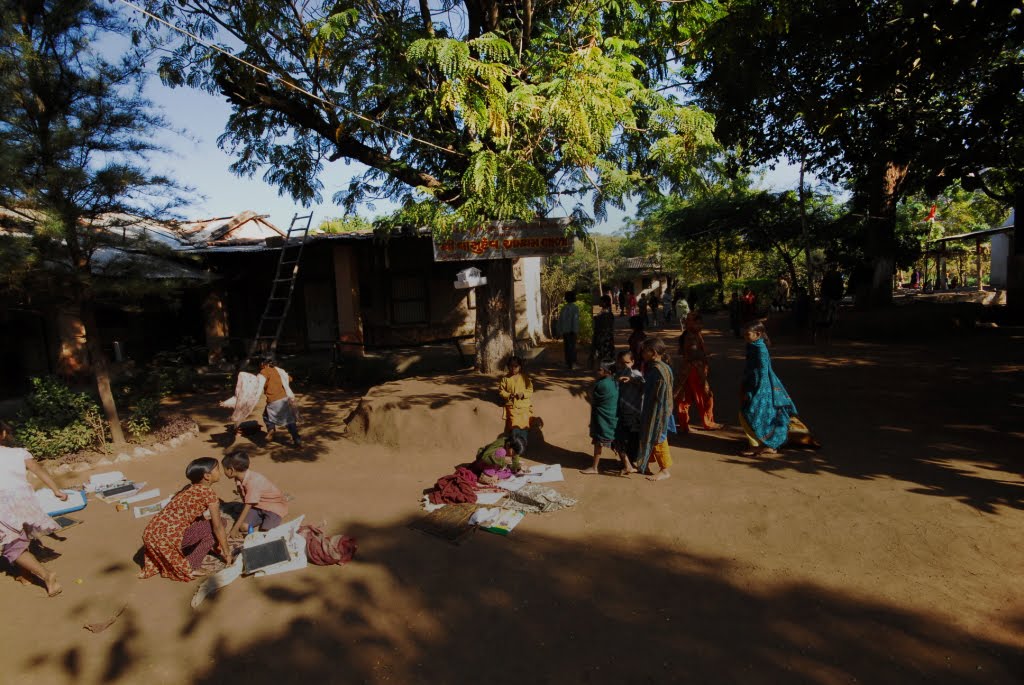
It was a day out camping with college students in forests of Jambughoda and we had set our base at an Ashram where 118 tribal kids (aged between 4 to 11 years) stay and study till their primary education is complete while their parents are farming or doing farm labour work in their native place. These kids not only stay and study there but are completely responsible for maintaining the sanctity of the place. It is at this Ashram where they spend the most important part of their lives which shape their future and ours’ too in a way!
We reached in the morning and the first sight I saw was, kids studying under trees in warmth of an early morning sun. There was no one to tell them to study, to instruct them to do this-do that. They were on their own it seemed, self-disciplined but innocence was not lost! They were very shy and did not allow me to photograph them but still I managed as I knew then, I need to carry this story back, share and do whatever little I can do!


Well, the place now! The place is surrounded by hills in Jambughoda forest which is rich in bio-diversity, be it insects, birds, reptiles or mammals. Very famous for Leopards and Bears! The Ashram is extremely clean as all the kids share their duties to keep it clean. They collect fallen twigs and branches for firewood, sweeping the rooms and keep the toilets and bathrooms clean. 

They sleep in a hall (a kind of dormitory), not on beds but on a mattresses (not thicker than a sleeping bag) with folded blankets as their pillow and an extra blanket to cover them! Next to their “bed” is what their world is…A metal “suitcase” in which they have, all they have! Books, a few clothes, some packs of biscuits, some toys, some hand made craft like a plate made out of leaves, a painting on paper of a world they perceive and a lot of priceless such things!


But how can I forget we were there camping! So the day began with the college students who paid us to buy the fun factor! We went for treks, caving, rappelling and other such activities. I saw them deriving a high by drinking water from a pond and saying “wow, this is so amazing!” which those kids drink and bathe with everyday!
Evening, we touched base and after a quick dinner it was time for the camp fire. Again something kids do it almost every day whenever it is cold. Being them I perceived that they would find it so amusing to see a bunch of crazy people singing near a fire place. All they do is derive warmth from the fire or to probably stop the shiver they have inside!!! Ya, so I perceive they had not seen people like us and it probably was a different world for them.

While campers sang and had fun by the camp fire, I saw some kids peeping out of the window, some wishing to join but cannot. But they seemed happy seeing the bunch of crazy people dancing by the fire place!

During the day even while I was trekking, caving, rappelling and talking to the campers, one thought was all the time in my mind and it was that something has to be done for these kids! That’s when this write-up and idea of generating funds for them in order to give them better education sprouted in my mind.

The conservation factor!!!


Well, now the selfish me is talking! My interest lies in the conservation! Well, when they finish their primary education some continue to pursue Secondary and Higher Secondary education, but mostly to return back to farming or similar activities. According to reports 60% of the country's forest cover is found in 187 tribal districts where less than 8% of national population lives. Forest Rights Act 2006 gives these Scheduled Tribes a “soft license” to use these forests and minor forest produce on which debates, agitations and legal battles are on between the supporters of Forest Rights Acts and conservationists. Now with the growing population of Scheduled Tribes the pressure on forests multiplies a many times. If these kids get proper exposure, education and training, they can get on an alternate livelihood than to depend on forests or cultivation on “once” forest land.


These kids need access to knowledge; much more than what is in their books they study! They don’t know what internet is, they don’t watch TV and don’t know what goes around the world or for that matter even in the country they live in, all they know is they have to wake up next morning, study books, clean the place, and finish their chores and occasionally watch city campers dancing and singing by the camp fire in amazement! The need is to broaden their vision so that they see much more and work not only in farming but much diversified areas. At least it will give them a better experience and learning which is what their right is!

 We need:
  • Used or brand new computers, laptops
  • A colour TV
  • A DTH connection with 1 years paid subscription
  • An LCD projector
  • Visiting Doctors
  • Visiting Trainers / Teachers who can conduct workshops on various subjects
  • And anything that you think would really contribute towards their betterment.
 Note: All equipments should be working condition, Doctors and Trainers too! :)
For further details and donations please contact:
Vipul Ramanuj

Monday, December 8, 2008

HELP THE BIRDS


Come January, citizens across the nation prepare to welcome the season of harvest through various festivals, Lohri in Punjab, Uttrayani in Uttrakhand, Bhogali Bihu in Assam, Sankranthi in Kerala, Pongal in Tamil Nadu, and Uttrayana in Rajasthan and Gujarat. While most states dance away to celebrate and welcome the season, Gujarat celebrates it by flying kites on January the 14th and 15th every year!


The vibrancy of the state, backed by "Vibrant Gujarat" brand name proudly adorned by the Government of Gujarat, is found in flying kites!!! What wrong in it is the "cut-throat" competition to cut kites of the other enthusiast, which straight away results in loss of the endangered bird life. Manja (Glass Coated Strings) which are razor sharp, cut the wings of the birds and are killed (if untreated) or grounded for life. The magnitude of the "massacre" multiplies as it coincides with the migratory season of the birds. Gujarat boasts of some of the best birding places with a number of sanctuaries dedicated to birds. Millions of birds visit Gujarat as they find it a safe haven, but really so?

A few NGOs learned this lesson and started to rescue birds which fell victim to the festivities, but soon realized how the state including THE FOREST DEPARTMENT is ill-equipped by all means to handle the disaster of this magnitude. Our National Bird, and "other" species of all Schedules are "butchered" as the state looks upon its vibrancy.

The apathy of the state is so bad that there is not even one good Bird Hospital (when you have lacs of birds visiting) with Gas Anesthetizer and basic surgical equipment. Veterinarians of the state have studied anatomy, biology, and medicines of cattle, dogs, and cats!!! Not even a single veterinarian is specializing in Avian Veterinary Sciences, who can handle critical surgical procedures or even operate a Gas Anesthetizer. The Gujarat State Forest Department does not have any veterinarian specializing in Birds!!!

See what actually happens PICTURE GALLERY/ SLIDE SHOW

So far the figures of NGOs rescuing and treating birds goes in thousands with a huge ratio of fatalities, thanks to insufficient funds, support, and expertise! Over 126 species of birds have been reported so far to be the victims of this festival. To name a few are: Indian Peafowl, Vultures (White-rumped, Eurasian Griffon, Egyptian), Crested Serpent Eagles, Owls, Peregrine Falcons, Laggar Falcons, Shikras, Flamingos (Our State Bird), Pelicans, Pigeons, Kites, Bats, and many shorebirds. Where World Authorities on Birds are trying their best by putting in all the available resources to save the species, Gujarat State looks upon (or rather not!) and sits haplessly.


The carnage is not limited to only two days, but more than a month...as people start flying kites right from December. Also, dangling Manjas (Glass-coated Strings) on the trees and buildings pose a huge threat to birds till the time they are dangling.

The need of the hour is to "Manage" the entire show, right from volunteer management to set up a fully equipped Bird Facility in the cities where the Kite Flying is a very high magnitude. To start up with Ahmedabad, Baroda and Surat! Bird Ambulances, equipment, the supply of medicines, trained managers, volunteers for birds' post-operative care, limited activity and flight aviaries, temperature controlled environs, a lot of knowledge and a Will To Do, is what is required! And of course, Good Veterinarians!!!


Doesn't the carnage or mass poaching of rare and endangered birds of the state fall under The Gujarat State Forest Department? or they are only out to protect, (???) equipped to protect (???) the wildlife within sanctuaries and national parks!!! Isn't this what a State Government is supposed to do? Definitely doing this may not earn Votes, but then there is so much more to it!!!

I am not here to demean anyone, but this is an attempt to convey, that it's about time that the State Forest Department takes on the charge and creates an example!!! The time for the Media to come up with Breaking News and The Headlines and for the people to understand! People may not stop flying kites, but at least birds can be rescued, treated and released to where they belong!!! After all, Gujarat is known for its hospitality, and we do not treat our guests like this, do we?


From the Land of Mahatma Gandhi, his words "A Society is judged by the way it treats it's animals"

PICTURE GALLERY/ SLIDE SHOW

Further Read:
http://www.hsus.org/about_us/humane_society_international_hsi/cruelty_issues_around_the_world/india_kite_festival.html
http://www.nationalbirdsofpreytrust.net/vultureconservation%20update%200907.pdf
http://www.gujaratglobal.com/nextSub.php?id=2159&cattype=NEWS
http://timesofindia.indiatimes.com/Cities/Docs_flock_to_save_winged_victims/articleshow/2688055.cms
http://timesofindia.indiatimes.com/articleshow/34499073.cms
http://timesofindia.indiatimes.com/articleshow/1173808.cms
http://timesofindia.indiatimes.com/articleshow/msid-425592,prtpage-1.cms
http://timesofindia.indiatimes.com/articleshow/991486.cms
http://timesofindia.indiatimes.com/articleshow/msid-1359139,prtpage-1.cms
http://timesofindia.indiatimes.com/articleshow/419246.cms

If Pakistan can, Why can't we?
http://news.bbc.co.uk/2/hi/south_asia/2978988.stm

Note: The Copyrights of the Photographs remain with the original photographers. If any of the images published is found objectionable by the owner, may contact me by email.